One Afternoon With the Hisense PX4 Pro: From Cardboard Box to a 150-Inch Wall
One afternoon, one wall, 150 inches. A hands-on look at the Hisense PX4 Pro console-style laser cinema, from unboxing and alignment to the first 4K frame — and what it costs against the TV it replaces.
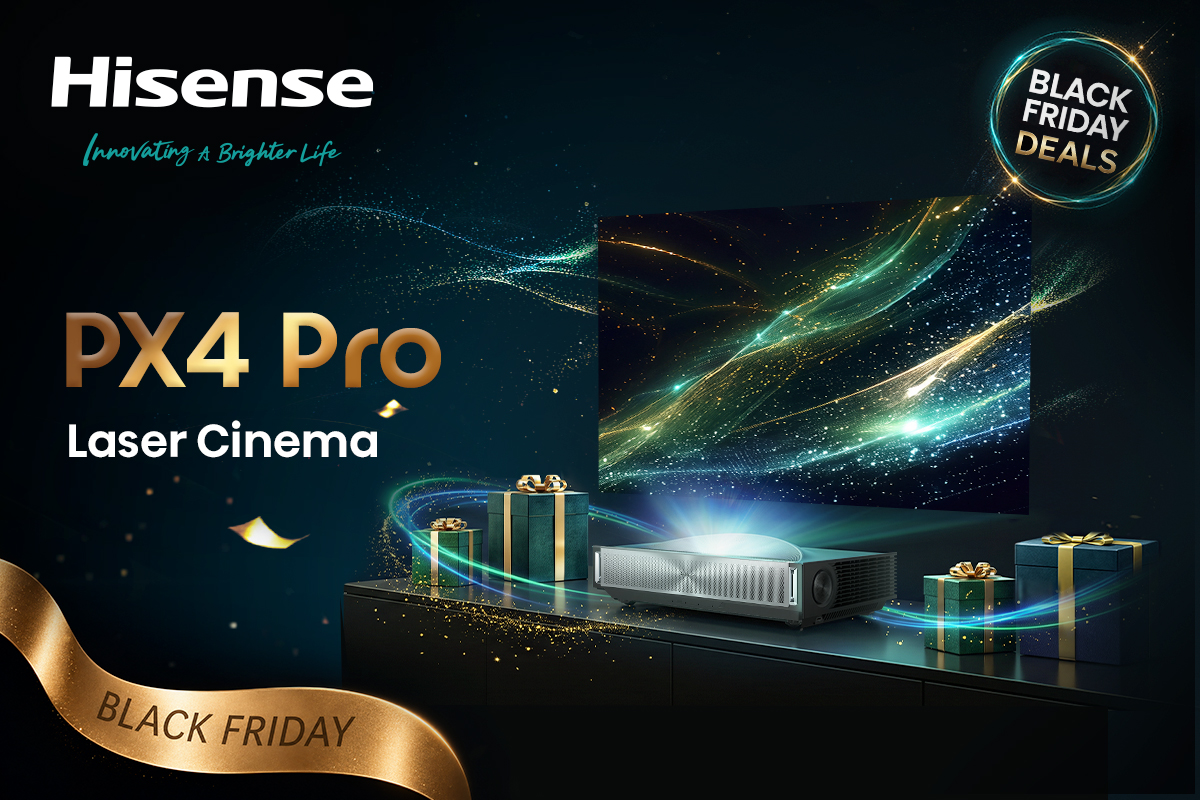
The pitch sounds like a parlour trick: a box the size of a large soundbar, sitting a few inches from your wall, throwing a picture bigger than anything Best Buy sells. Then you unbox the Hisense PX4 Pro, set it on the media console, press power, and the trick stops being a trick. The wall lights up at 120 inches, autofocus and auto-keystone square the image in about ten seconds, and the scale does something no TV can do: it changes the room.
The PX4 Pro lists at $3,999.99 and is $3,499.99 for Black Friday, at Hisense's own store and on Amazon. That's roughly half the price of a good 98-inch TV, for a picture twice the diagonal. We spent time with it the way an owner would, streaming, gaming, blinds up, blinds down. Here's the visit.
Prices checked November 2026.
Setup is genuinely an afternoon, not a project
The fear with projectors is the installation: ceiling mounts, cable runs, alignment, darkness. Ultra-short-throw deletes all of it. The PX4 Pro's 0.2 throw ratio means it sits where a soundbar sits, connected to nothing but power and Wi-Fi. The VIDAA smart platform has the major streaming apps built in, so the first movie can start within minutes of the courier leaving. Nudge the unit back a few inches and the image grows toward its 200-inch maximum; nudge it forward and it settles at a tidy 100. Nothing gets mounted. Nothing gets drilled. The console you already own is the entire installation.
The color engine is the reason to buy
Almost every projector under $2,000 makes its picture from a single lamp fired through a spinning color wheel, and it shows: reds drift orange, blues lean purple, and everything reads faintly "projector." The PX4 Pro's LPU Digital Laser Engine 3.0 runs three dedicated lasers, one each for red, green and blue, and covers 118% of the BT.2020 color space, the widest gamut consumer content is mastered in, and wider than nearly any TV panel sold, OLED included.
What that looks like at 150 inches: Dune: Part Two's twin suns sear instead of squint, an F1 broadcast keeps its reds and greens at opposite ends of the frame, and animation looks painted. Brightness is 3,500 ANSI lumens, enough that afternoon football with the blinds up is a normal thing to watch, and a dynamic iris rated at 6,500:1 keeps night scenes layered after dark. The format stack includes Dolby Vision, HDR10+ and HLG, so your streaming library plays in its best-mastered version, a rarity among projectors at any price.
The laser source itself is rated for 25,000+ hours: at five hours a day, that's a decade of viewing with no lamp replacements and no dimming anxiety.
The part that made us stop and replay it
Midway through the visit we plugged in a controller, and this is where the PX4 Pro stops having peers. It is the first ultra-short-throw projector ever certified for FreeSync Premium, a first Hisense announced at launch and specialist press confirmed. It runs 1ms latency at 2K 240Hz, supports VRR, and has Xbox Cloud Gaming built into the platform, so a Game Pass subscription puts Forza on the wall with no console in the room at all.
The history here matters: projectors used to be unplayable for fast games, full stop. The PX4 Pro doesn't just fix the lag, it out-specs most gaming TVs on refresh. A 150-inch screen that plays like a monitor is not a category that exists elsewhere.
What it costs against
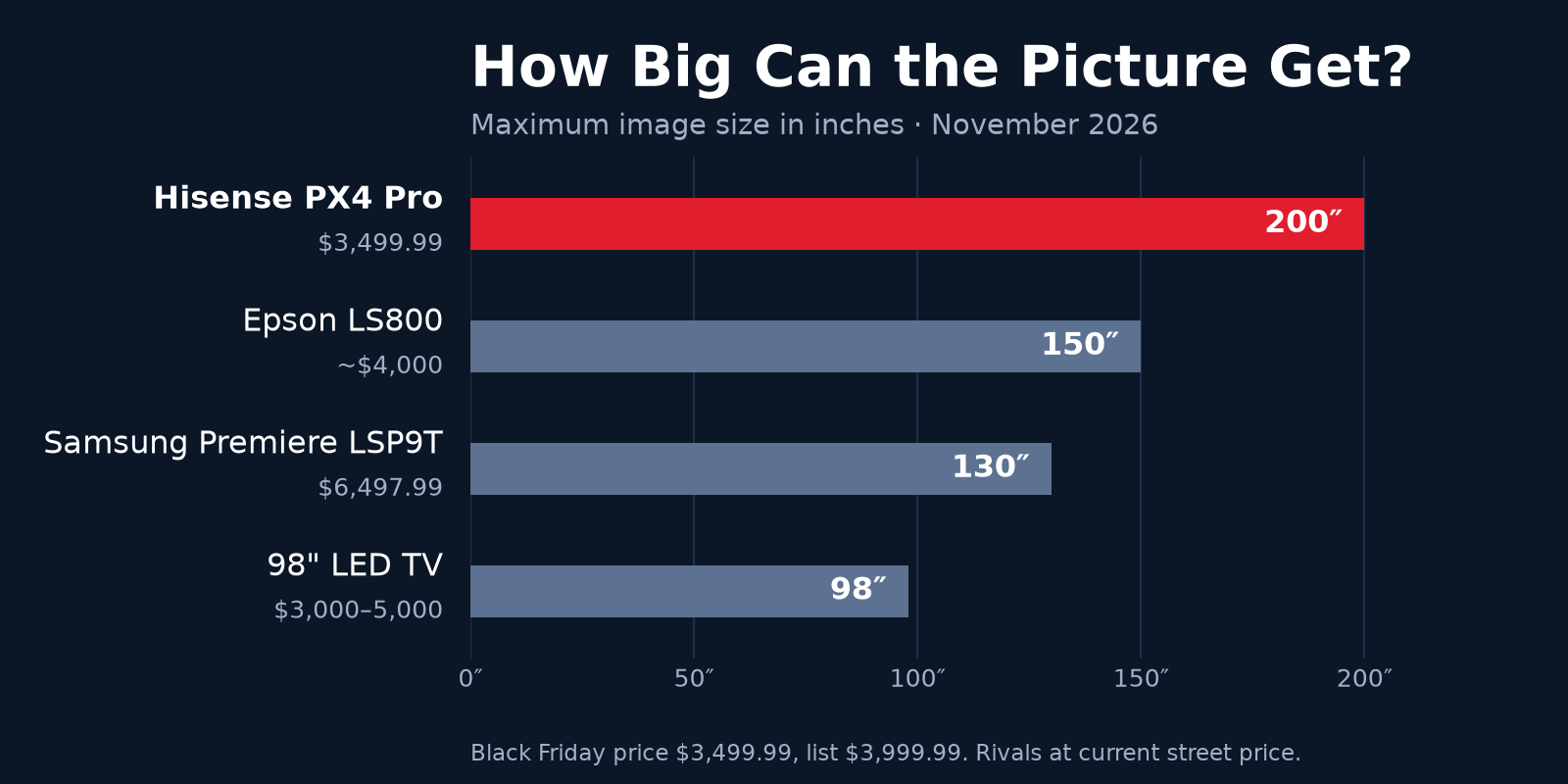
Maximum picture size: the PX4 Pro against UST rivals and a 98-inch TV.
| Hisense PX4 Pro | 98" LED TV | Samsung Premiere LSP9T | Epson LS800 | |
|---|---|---|---|---|
| Price | $3,499.99 | $3,000-5,000 | $6,497.99 | ~$4,000 |
| Max image | 200" | 98" | 130" | 150" |
| Brightness | 3,500 ANSI | Panel-dependent | 2,800 lumens | 4,000 lumens |
| HDR | Dolby Vision, HDR10+, HLG | Varies | HDR10+ | HDR10, HLG |
| Gaming | FreeSync Premium, 1ms @ 2K 240Hz | Varies | No VRR | Low-lag HDMI |
The Premiere LSP9T is the prestige rival, and it costs about $3,000 more while delivering 700 fewer lumens, a 130-inch ceiling, no Dolby Vision and no adaptive sync. The Epson LS800 throws a lovely, color-safe 3LCD image but stops at 150 inches and skips Dolby Vision entirely. And against the 98-inch TV route, the math is blunt: similar money, twice the diagonal, zero installation. Specialist coverage has settled on the same reading, treating the PX4 Pro as the value leader in laser cinema. It also sits about $1,000 above the PX3 Pro it replaces, buying a brighter engine and the entire gaming stack, which makes it one of the rare generational steps worth paying.
Building it out
The system grows nicely. An ambient-light-rejecting screen ($500-1,000) lifts the iris's contrast even higher in bright rooms and is the first accessory worth adding; a soundbar or receiver finishes a true cinema room. And if some movie nights happen away from the living room, Hisense's own C3 family (C3 Pro is the value pick at $1,999.99) puts the same triple-laser color on a gimbal you can aim anywhere.
Check current PX4 Pro pricing on Amazon. It lists at $3,999.99 and is $3,499.99 for Black Friday, so check the live number before paying list anywhere.
Tags
Related Articles

10-Minute Daily Home Reset for Working Moms (That Actually Works)
A realistic 10-minute daily home reset routine for working moms. No marathon cleaning—just small, doable habits that keep your house from spiraling.
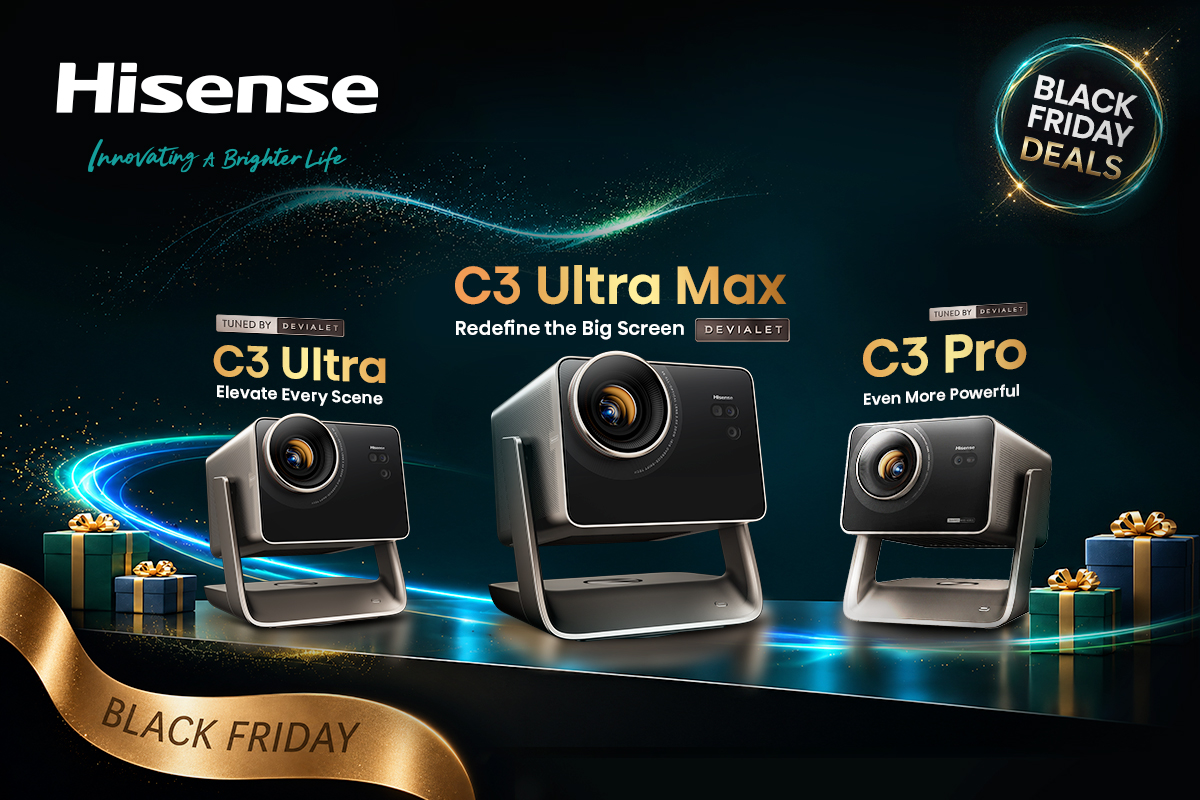
Which Hisense C3 Projector Should You Buy? Match Your Room in 30 Seconds.
C3, C3 Pro, C3 Ultra or Ultra Max? A 30-second guide to matching the right Hisense triple-laser projector to your room, your light and your budget — with the specs and prices side by side.
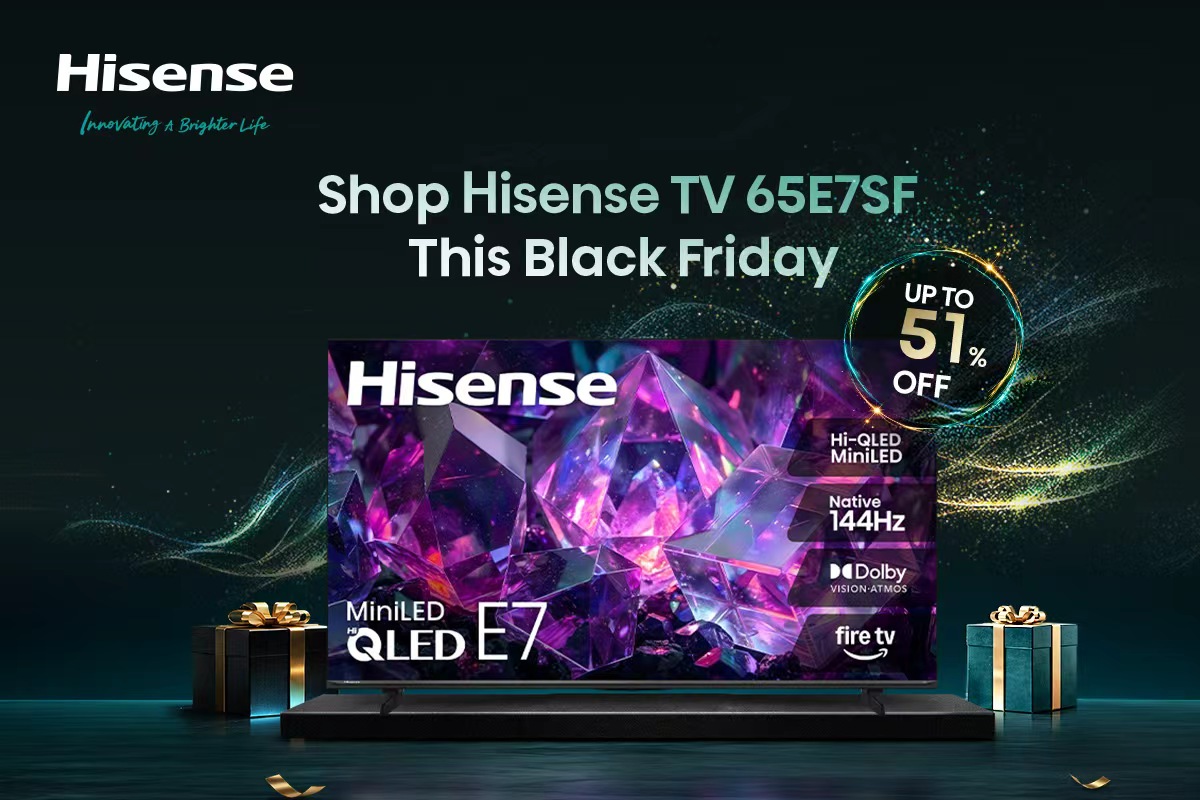
The Hisense E7 (65E7SF) Is a $1,000 TV Selling for $450-600. Here's What's Actually in the Box.
The 65-inch Hisense E7 (65E7SF) pairs Mini-LED with up to 264 dimming zones, a native 144Hz panel and full Dolby Vision for $499.99 — half its $999.99 list. Here's what is actually in the box.